

Postmodernists claim
that feature films
are just as
a source at discovering
history as any
other methods of
gathering evidence to create a bigger picture of
the past. Cinema
and film are
undoubtedly of huge cultural and
social significance, millions of people
go to the
cinema, in 2011
1.28 billion tickets
were sold in
the US alone[1], to watch the latest Hollywood
blockbuster, so what better place
is there to
contain a message
or tell history?
The audiences look on as films look into
the past telling
us stories of
the Second World
War, Vietnam War
and of racial
injustice in America.
However, can feature
films such as
Oliver Stone’s Platoon (1986), Michael Cimino’s
The Deer Hunter (1978) and
Steven Spielberg’s Saving Private Ryan (1998) be
used as evidence
to paint a
picture of the
Vietnam and Second
World wars? Or
do films like
the 1915 film
The Birth of a Nation (a
film undoubtedly racist but also one of the most important films in American
cinema for its technical innovations) present difficulties at using film
as a historical source?
There are many
issues at using
film as a historical
source, however, there are also
many positives and these positives outweigh the dangers of using film as a historical source.
Subscribe To Myerla

 Posts
All Comments
Monday, 20 February 2012

Sunday, 12 February 2012
The Woman in Black

It's 11 days into the shortest
month of the year and The Woman in Black is the first 2012 film I have actually
seen, of course Britain often gets films after the US, but from the 2012 films
released so far, very few have been of particular interest to me, and some I
have not had the time to see. Anyway, many will know of the stage play of The
Woman in Black, which is the second longest running play in the history of West
End, which has been terrifying people for the past 23 years, both the book and
the play are held in high regard, can the film do both the novel and the play
justice?
Tuesday, 7 February 2012
No Beginners luck required for Sean Durkin as Martha Marcy May Marlene is superb, but The Debt he owns Lizzie Olsen is huge. (Sorry, best I could do.)
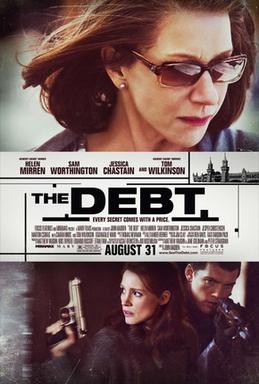
Directed by John Madden (the
director of the 1998 Best Picture Winner Shakespeare In Love )The Debt is a rather forgettable story
of revenge. The Debt is a remake of a 2007 Israeli film of the same name and
stars Jessica Chastain, Sam Worthington and Marton Csokas as MOSSAD (the
Israeli intelligence service) agents planning to kidnap notorious war criminal Dieter
Vogel – aka The Surgeon of Birkenau – played by Jesper Christensen.
These three agents wish to bring back this Nazi war criminal to Israel and give
him the justice he deserves. The story is told in a nonlinear narrative as the
plot flashes back from the early 60s to the year 1997, and this is done with
some success in terms of narrative, but does present some clear casting issues.
Within the hour the film loses its spark and its power to entertain despite the
rising tensions and tempers between the central characters as they spend far
too much time cooped up in a dingy little house. The two male agents, Stefan Gold and David
Pertez (Csokas and Worthington) are rather unprofessional as they develop
feelings towards Rachael (Chastain and Helen Mirren) who swings between the two
male characters, but this melodrama is rather tiresome and mundane. The
performances are fine as the cast is made up of some well known stars
(Chastain, Helen Mirren and Worthington) but the older versions of the
characters look nothing like their younger selves so, at first, one cannot be
certain to who is who, with the exception of Rachel Singer. One does wonder why
they couldn’t use make up. That aside The Debt is still rather uninvolving due
to the fact that these characters, who we spend a great deal of time with, just
are not interesting enough.
Saturday, 28 January 2012
Coriolanus review.

The most well known example of Shakespeare’s works being adapted into a modern setting, but with his older form of the English language intact, is Baz Luhrmann’s Romeo and Juliet (1996) which had all the aspects of the modern age (cars, guns, etc) but kept the Shakespearian dialogue. It was an attempt to get younger people more interested in Shakespeare, it worked to an extent that Leonardo Di Caprio became a teenage heart throb and starred in that little known film Titanic. The film is also more popular among audiences then many Shakespeare adaptations. Ralph Fiennes also adapts Shakespeare’s Coriolanus in a modern setting (with Belgrade standing in for Rome), and this is also a play with some relevant political undertones when considering the political climate of today.
Thursday, 19 January 2012
War Horse review

Steven Spielberg is a master at tugging the heartstrings;
films like E.T, Saving Private Ryan and Schindler’s List are a perfect example
of this. Spielberg has gotten some criticism for being too overly sentimental,
while there is a foundation to build an argument upon it is unfair to use that
one critique to discredit the amazing body of work Spielberg has done. War
Horse is another one of those tear jerking Spielberg movies, while it is
poignant, War Horse is not in the same league as ET.
Saturday, 14 January 2012
The Iron Lady

Margret Thatcher is a woman who
invites a great deal of strong opinions, her ruthless taxes and cost-cutting
policies spilt the nation, undoubtedly she has become one of the most hated
Prime Ministers in British history. The Iron Lady (Thatcher was given that
nickname by communist Russia) concerns Margret Thatcher (Meryl Streep) in her elderly
years and in declining health as she is suffering from dementia which causes
her to have hallucinations of her late husband Denis (Jim Broadbent). The main
focus of the story is Thatcher’s old age, but the film revisits the major
moments of Thatcher’s life, and political career such as the Falkland’s War, her
controversial policies and how she became the most powerful person in the
country in an area dominated by men.
Thursday, 12 January 2012
The Artist

Alfred Hitchcock once said ‘If
it's a good movie, the sound could go off and the audience would still have a
perfectly clear idea of what was going on’ The Artist is one of those films.
Without dialogue for 99.9% of its running time The Artist is quite a niche
product for Harvey Weinstein Production Company and it has turned out to be an
absolute critical hit and a favourite for Best Picture Oscar (which would be
company’s second Best Picture in a row).
Subscribe to:
Posts (Atom)